

If breakers keep tripping, or you are planning an EV charger, a hot tub or a heat pump, the question of panel size comes up fast. Sometimes a 100-amp service is plenty, and sometimes it is not. Here is how we work out whether a home in Cambridge or Waterloo Region needs a bigger service, a new panel, or neither.
Signs your panel or service is running short
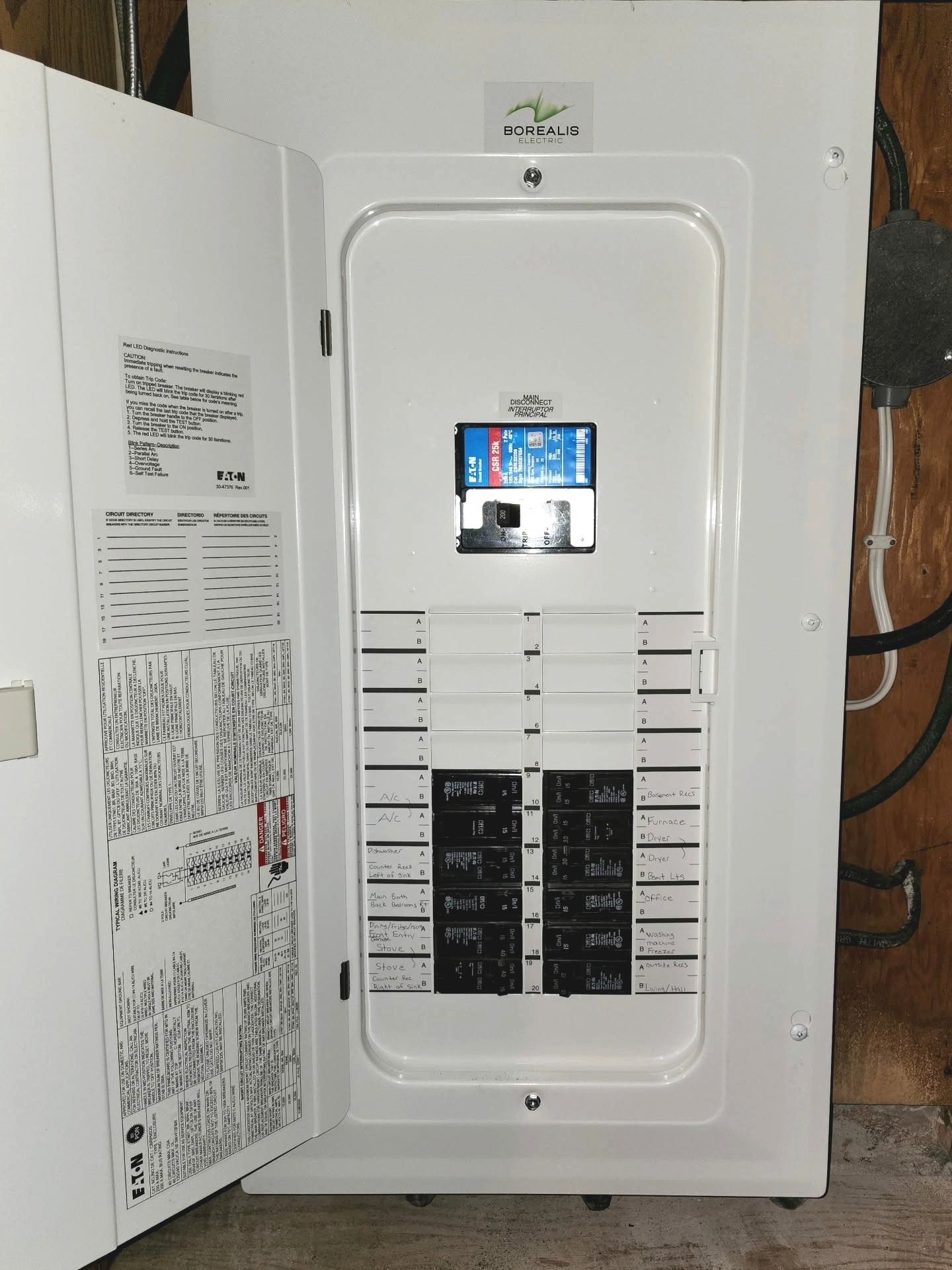
Your panel (the breaker or fuse box) and your service (the equipment that brings power in from the utility, rated in amps) are related but not the same thing. Either one can be the limit.
Things to watch for:
- Breakers that trip often, or fuses that blow. ESA’s homeowner safety handbook says circuits that frequently trip, fuses that blow and overheated plugs or outlets point to an overloaded circuit or possibly faulty wiring or equipment, and it advises calling a licensed electrical contractor as soon as possible. Do not keep resetting a breaker that keeps tripping.
- Dim, surging or flickering lights. ESA notes these can be a sign of a loose connection in a lighting circuit, a fixture or your electrical service.
- No room for new circuits. If every space in the panel is used, a new kitchen or a finished basement means something has to change. Our basement renovation guide covers that planning.
- A big new load on the way. A Level 2 EV charger, a hot tub or swim spa, a heat pump or an addition all add demand. Enova Power lists added living space and a new pool among the common reasons for a new or upgraded service.
- An older fuse panel. If you are renovating or adding a major appliance anyway, it is a sensible time to look at replacing it. If your insurer has asked about it, ask them exactly what they need from you.
100 amps or 200 amps: the load calculation decides
The Ontario Electrical Safety Code sets out how to calculate the minimum service for a house. The calculation starts from the living area, then adds major loads such as space heating, air conditioning, the range, water heating and EV charging equipment. We run it before recommending anything.
Two examples from ESA’s bulletin on load calculations show why there is no single answer:
- ESA says a typical calculation for an average 2,500 sq. ft. home without electric heat, with a range, an air conditioner and a dryer, comes to 85 A, and that actual demand in a home like that has been found to be lower than the calculated load.
- In a worked example, a 1,500 sq. ft. (140 m²) home with central air, an electric range, a dryer, an electric water heater and a 32 A Level 2 EV charger needs a minimum 125 A service. ESA notes that figure does not account for an EV energy management system.
Heat pumps matter too. ESA has clarified that a heat pump’s nameplate rating is counted in full, so swapping a gas furnace for a heat pump can change the math.
So 200 amps is not automatically the target. The right size comes from the calculation and from what you plan to add over the next few years, not from a rule of thumb.
A bigger service is not always the answer
The code also offers ways to add load without upgrading the service:
- Your real usage. ESA’s bulletin allows the calculation for adding a load, such as a hot tub or EV charger, to an existing house service to use 12 months of usage data from your utility. The existing service can be enough if the peak demand worked out from that data, plus the full nameplate rating of the new load, is no more than the service rating.
- EV energy management. ESA Bulletin 86-1-7 explains that an energy management system (EMS) can monitor loads and automatically control an EV charger. When the EMS monitors the home’s service and controls the charger, the charger’s demand does not have to be included in the calculated load. ESA says an EMS is permitted in any type of building, and with one installed, a charger can even share a circuit with other loads.
- Adjustable chargers. Some chargers can be set to a lower maximum current. ESA allows that setting to be used for circuit sizing on fixed-in-place chargers when the manufacturer’s instructions are followed, a permanent label is posted and access to the setting is restricted.
- A panel change instead of a service upgrade. Sometimes the service is big enough and the panel is simply full or worn out. GrandBridge Energy says a panel change with no upgrade or relocation does not need a service layout; the contractor books a disconnect and reconnect, which GrandBridge calls a cut and hold.
Our Level 2 EV charger guide and hot tub and swim spa guide go into those loads in more detail.
What a service upgrade involves in Ontario
- Assessment and load calculation. We look at the panel, meter base and service entrance, then run the numbers with your plans in mind.
- ESA notification. As the licensed electrical contractor, we file a notification of work with the Electrical Safety Authority before work starts. Our guide to ESA permits explains how that works.
- Utility paperwork. Your local utility has to be involved. In Cambridge, including Galt, Preston and Hespeler, that is GrandBridge Energy, which also serves Brantford, North Dumfries and the County of Brant. GrandBridge requires a service layout for a service upgrade (an increase in amperage) and says layouts take about three weeks, depending on scope. In Kitchener and Waterloo it is Enova Power, which also serves Wellesley, Wilmot and Woolwich and asks for a service request form for an upgrade. Elsewhere, it is the utility named on your bill. ESA describes the service layout as setting out what the utility will supply and install and what the homeowner must provide.
- Upgrade day. The utility disconnects power, and we replace the customer-owned equipment and the panel. Enova, for example, lists the service mast and meter base as customer-owned equipment.
- ESA review and reconnection. ESA’s homeowner guidance says a service upgrade needs to be inspected before power is restored, and after a successful service inspection ESA authorizes the utility to reconnect. GrandBridge states it will not reconnect a service without an ESA inspection.
- Paperwork for you. Once the work is accepted, ESA issues a Certificate of Acceptance to whoever filed the notification. Ask for a copy; ESA calls it an important document for insurance and resale.
One warning sign from ESA’s own list of unlicensed contractor red flags: someone who says you do not need to involve your local electric utility to change your panel or upgrade your service.
Staying safe in the meantime
Leave the panel cover on and do not keep resetting a breaker that trips over and over. If you notice a burning smell, scorch marks, or plugs and outlets that are overheating, stop using that circuit and call a licensed electrical contractor. If there is smoke or fire, get everyone out and call 911. Our guide on what to do in an electrical emergency has more.
Panel installations and service upgrades are part of our residential electrical services. Borealis Electric is owned by a Master Electrician, holds ECRA/ESA licence 7017294 and is fully insured. If you are weighing a panel upgrade, an EV charger or a hot tub, contact us for a free quote.
Sources
- ESA Bulletin 8-3-16: Maximum circuit loading and demand factors (May 2025)
- ESA Bulletin 86-1-7: Electric vehicle charging systems (May 2025)
- ESA: Notifications and Inspections
- ESA FAQ: Notifications and Inspections
- ESA Homeowner Electrical Safety Handbook: Inside the Home
- ESA: Electric Vehicles and Charging Systems
- ESA: Identifying an Unlicensed Electrical Contractor
- GrandBridge Energy: About Us
- GrandBridge Energy: Service Layouts
- GrandBridge Energy: Service Requests
- Enova Power: About Us
- Enova Power: Developers and Contractors Information
General information for Ontario, current when published. Electrical work in Ontario must meet the Ontario Electrical Safety Code; talk to a licensed electrical contractor about your situation.